I was not the person you'd have bet on.
I was an ordinary software developer at an ordinary company. When the material got dense — control theory, state estimation, anything with a Jacobian in it — I froze and quietly went back to what I already knew. It took me ten years to work out how to walk through that wall instead of stopping at it. Everything I sell is an attempt to make that take you less than ten years.
Nobody told me the material was badly ordered. I assumed I was the problem.
Every robotics resource I found started in the same place: install this operating system, clone this workspace, run this launch file. When it worked, I hadn't learned anything — I'd typed accurately. When it didn't, I had no model of the system in my head to debug against, so I read more tutorials, and the loop closed on itself.
What eventually broke it wasn't intelligence or discipline. It was ordering. Write the naive thing first, in a language you already speak. Watch it fail in a specific way. Then learn the tool that exists to fix that specific failure. Once you've felt the problem, the professional machinery stops looking like arbitrary ceremony and starts looking like an answer.
That's the whole pedagogy behind these programs, and it's not a marketing theory. It's a reconstruction of the order I wish someone had handed me in year one.
Robots that have to work when nobody is watching.
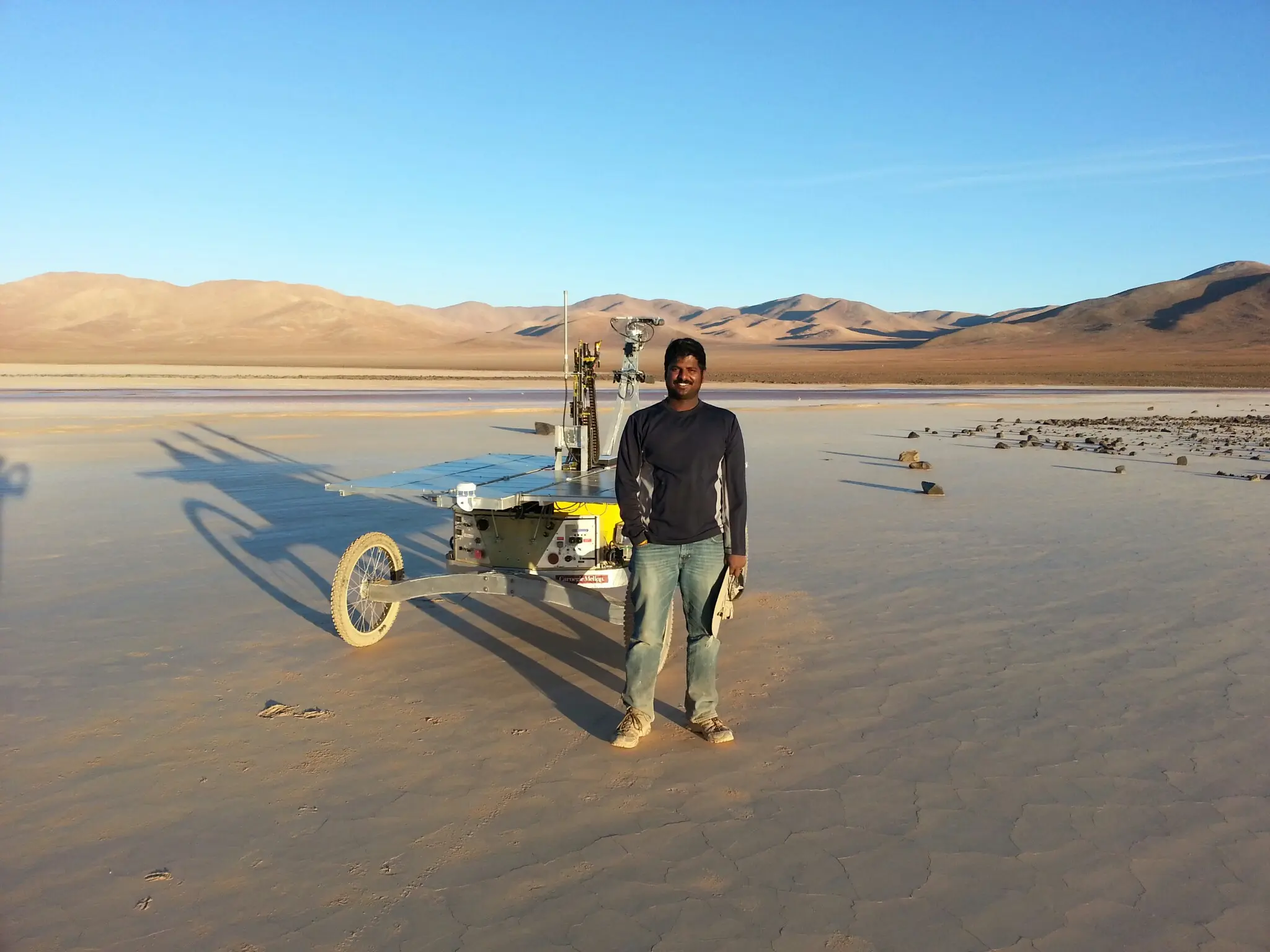
I hold a PhD in robotics and I'm a project scientist at Carnegie Mellon, where I still build and deploy systems. My work has been published at ICRA, IROS and RSS, and I've led field teams on programs for NASA, Yamaha and Boeing.
The line that matters more than any of that: most of my robots have run somewhere I couldn't reach them. A desert, a mine, a field, a place with no network and no second chance. You don't SSH in and patch it. You don't roll back the deploy. Whatever you shipped is what runs, and if you were wrong about the terrain, the lighting, the wheel slip or the clock, you find out by watching it fail from a distance.
That experience is the only genuine thing I have to sell. Anyone can demo a robot that works. I know what the twenty minutes after it stops working look like, and that's the part I teach.
Two people who have watched me work for years.
"Srini is a superb communicator… He is masterful, effective and at ease presenting technical information to stakeholders beyond his diverse group of team members across age, culture, and gender… Srini has a great skill in distilling technical concepts into the right level for different people and audiences…"
"Srini has applied his research to mining, aerospace, medicine, agriculture and space robotics. The number and breadth of research activities and contributions is exceptional… Dr. Vijay is considered a world authority in the field of mobile robotics."
Those are endorsements of my work, not reviews of these programs. The only student quote I have is on the homepage, and it's from the one-on-one coaching that predates this ladder. I'd rather show you three real quotes and say where each came from than twenty I can't source.
Small groups at a real price, not a cheap course for everyone.
I could sell a $49 video course to thousands of people. It would make more money per hour of my time and almost none of those people would finish, because the thing that stops you isn't access to information — you already have all of it, for free, in better quality than I could produce.
What stops you is being stuck at 11pm on a Tuesday with a transform tree that won't resolve and nobody to ask. So the programs are built around the scarce thing instead: sequencing that assumes you're an adult with a job, and access to someone who has debugged this before. Level 1 is open to anyone who can write some code, by a short application I read myself, and gives everyone the same well-ordered path. Level 3 takes three people at a time, because that's the honest capacity for the amount of attention it promises.
Every program runs a fixed term — eight weeks for Foundations, twelve for The Forge and Elite — and stops on its own. There is no auto-renewing plan anywhere on this site, and there never will be — if you want to keep going, you should have to decide to.
Things people ask me before they buy.
Read me for free for a few weeks before you pay me anything.
I write one long essay a week about what actually happens when robots meet the physical world. It's the cheapest way to find out whether you can stand listening to me for a whole program.